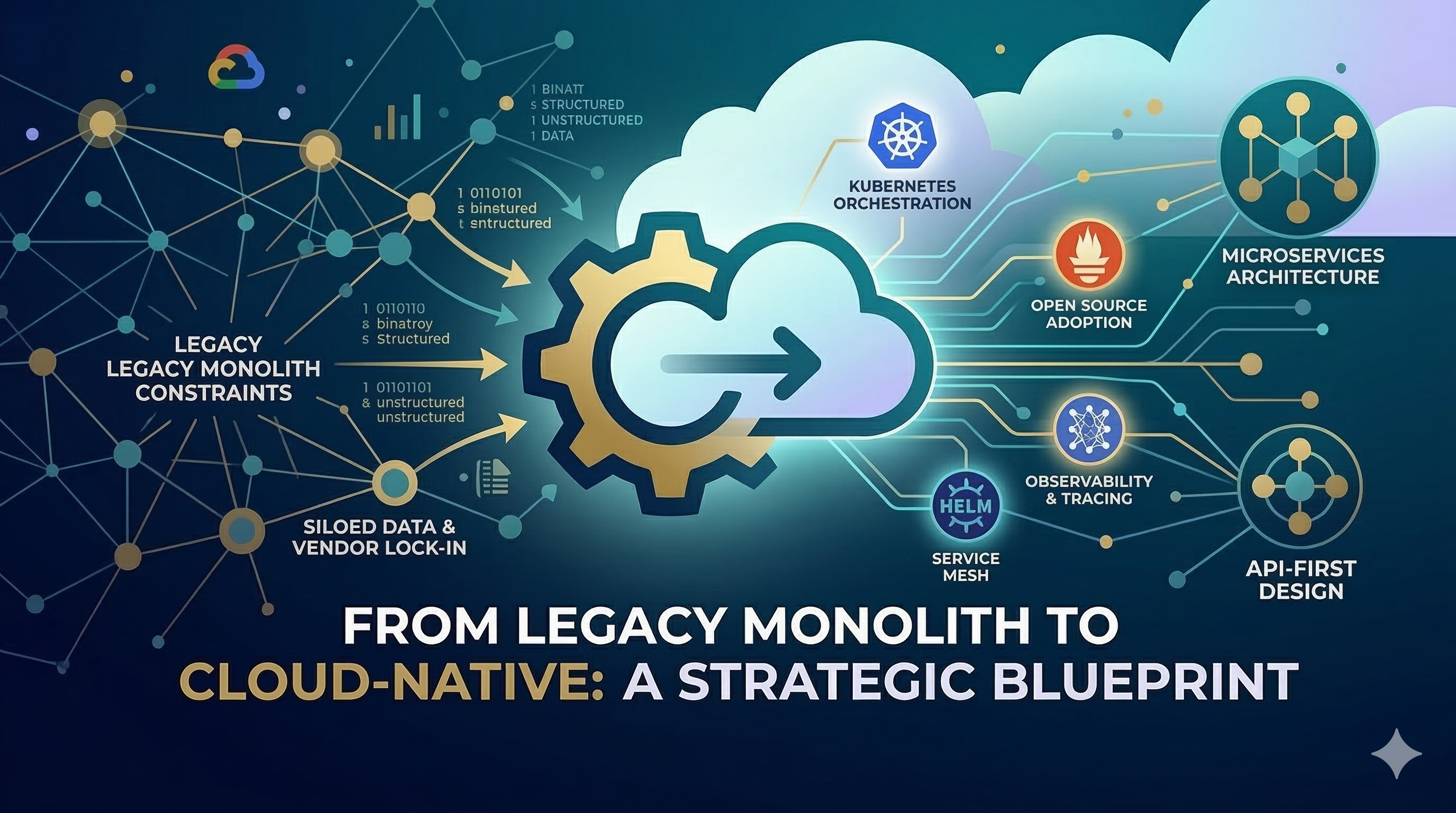
Enterprise Transformation Blueprint: Monolith to Cloud-Native
Digital transformation for a large organization is less about "flipping a switch" and more about "rewiring the plane while it's flying." For an enterprise reliant on legacy systems, adopting a modern stack cloud-native, open source, and microservices is not optional; it is a prerequisite for survival.
Success requires a strategy that balances the need for innovation speed with operational stability. Here is the suggested expert roadmap for navigating this crucial evolution.
The Core Methodology: Deconstruction and Migration
To move a large organization safely, we must use two core principles: one for architectural clarity and one for execution stability.
1. Domain-Driven Design (DDD)
DDD is a philosophy that matches software structure to actual business domains. It helps identify natural boundaries where business logic and data are distinct. This is the "map" for transformation.
- Bounded Contexts: We draw boundaries around specific business areas (e.g., separating "Shipping" from "Billing") to define clear ownership and prevent tangled models.
- Ubiquitous Language: We enforce a shared language between developers and business stakeholders. If the business calls it a "Policy," the code must also call it a Policy.
2. The Strangler Fig Pattern
Named after the Australian fig tree, this is the gold standard for migration. We develop new functionality around the legacy system, creating a "facade" (API Gateway) that intercepts traffic.
- When a request comes in for the migrated feature, the proxy routes it to the new cloud-native service.
- All other requests are still handled by the legacy system.
- Over time, features are "strangled" one by one until the old system dies.
The Transformation Roadmap
This phased approach ensures large organizations minimize risk while building momentum.
Phase 1: Strategy and Assessment
Before touching code, audit the portfolio. We use the "6 Rs Framework" (Retire, Retain, Rehost, Replatform, Refactor, or Rearchitect) to categorize applications. We apply DDD to identify the precise boundaries for the future architecture.
Phase 2: Establishing the Foundation
Large organizations cannot be cloud-native without a standardized "Landing Zone."
- Infrastructure as Code (IaC): We enforce reproducible environments (Terraform, OpenTofu).
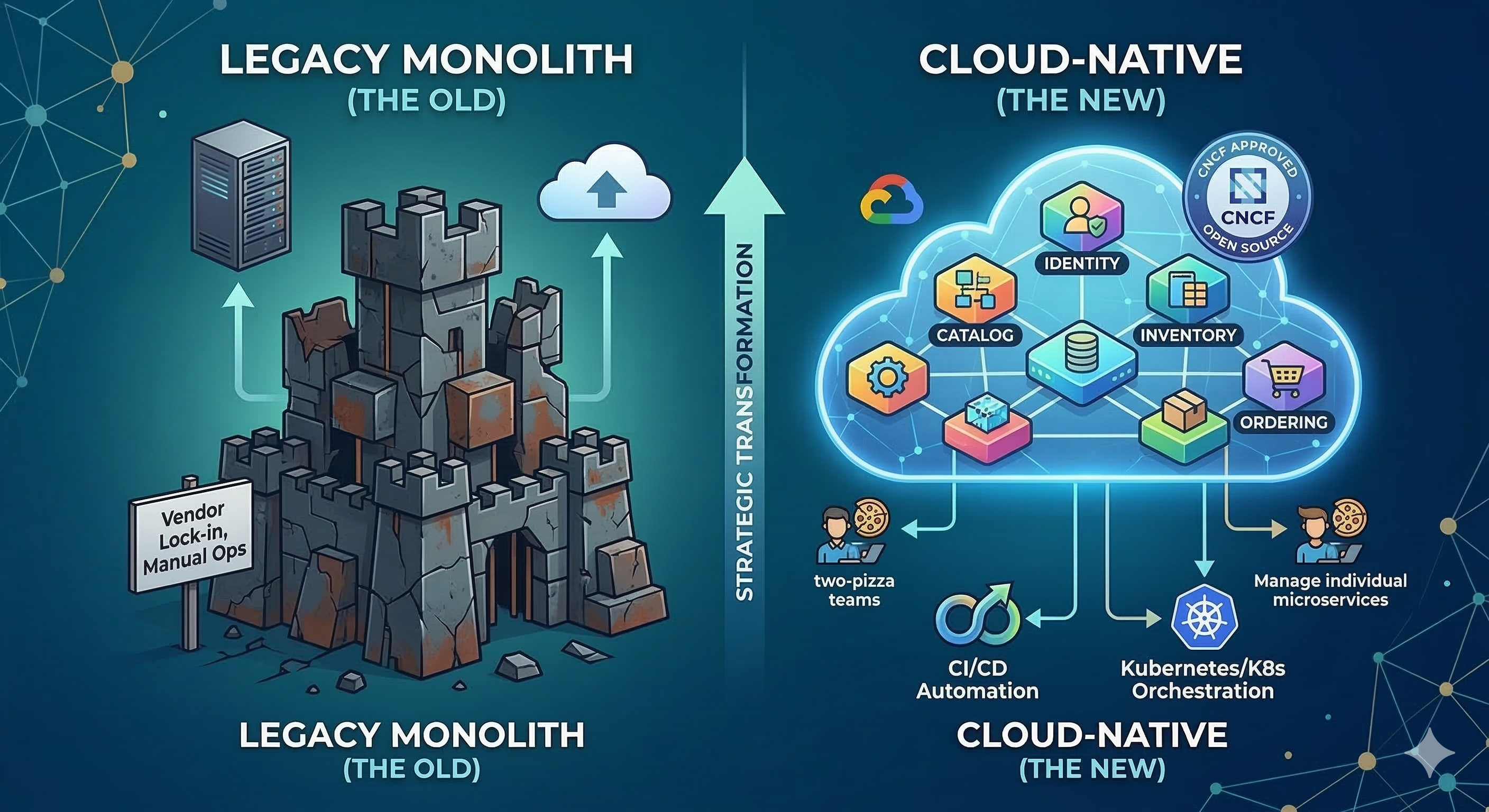
- The "Golden Path": We build internal developer platforms that provide secure, CNCF-approved templates for open-source stacks.
Phase 3: Migration and Tooling
Execute the Strangler Fig approach. Start with small, non-critical services (like a Notification engine) to build confidence.
- Orchestration: Standardize on Kubernetes (K8s).
- Observability: Implement Prometheus (monitoring) and Jaeger (tracing) to manage distributed communication.
- Event-Driven Communication: Use Apache Kafka or RabbitMQ to ensure asynchronous decoupling.
Phase 4: Cultural Transformation
Culture is 70% of the battle. Break down silos.
- Two-Pizza Teams: Empower small teams that own a service end-to-end (design, build, run).
- CI/CD and Automation: If it's manual, it is a bottleneck. Automation must be a mandate.
- Fail-Fast Mentality: Implement Chaos Engineering (e.g., Chaos Mesh) to test resilience proactively.
Summary of the Paradigm Shift
| Feature | Legacy Approach | Cloud-Native / Open Source |
|---|---|---|
| Deployment | Manual / Bare Metal | Kubernetes / Containers |
| Architecture | Monolithic | Microservices / Serverless |
| Scaling | Vertical (Bigger Servers) | Horizontal (More Pods) |
| Data | Centralized RDBMS | Polyglot (NoSQL, NewSQL, Cache) |